
Industry Loss Warranties (ILWs) provide investors with direct access to defined catastrophe insurance markets enabling clearly diversified investment opportunities at attractive rates of return.
What is an Industry Loss Warranty (ILW)?
An Industry Loss Warranty (ILW) is a contract that pays out in response to the overall insurance industry’s loss experience in respect of a predefined industry loss type and amount by way of a reference index. The reference index is provided and maintained by an independent third-party reporting agent with the responsibility for collating the loss experience information for the insurance industry.
This benefits the investor in obtaining index exposure to the performance the total insurance market within distinct geographies and risk types, whilst avoiding the need to assess and select between different individual insurance companies.
When compared to a catastrophe bond exposure, ILWs can offer the opportunity for a more tailored investment strategy enabling shorter time on risk (12 months or even less e.g. some Named Windstorm contracts are bought to cover Hurricane season only from June 1 to November 30 or sometimes even shorter). Additionally, ILW investors can target different risk/return profiles, with the opportunity to include more aggressive investment opportunities than can be available to cat bond investors.
Workings of an ILW
An ILW has a predefined loss threshold (attachment point) that needs to be exceeded for the transaction to pay out to the counterparty. Losses after this threshold are often calculated proportionally until they reach the exhaustion point. However, binary (e.g., fully paid after exceeding the attachment) or stepwise payouts are also common practice.
The payout mechanics are similar to stock options, where an investor has the right, but not the obligation, to buy or sell a stock at a specific strike price within a certain period. This strike price is the critical point at which the option becomes valuable: if the market price surpasses the strike price (for a call option), the investor can purchase the stock below market value, potentially securing a profit or hedging against price fluctuations. Similarly, an ILW has a predetermined loss threshold that acts much like the strike price in options, serving as the trigger for the contract's benefits. If actual losses surpass this point, the ILW pays out, helping insurers manage exposure to catastrophic events. This is similar to selling a call option on industry losses.
ILW coverage
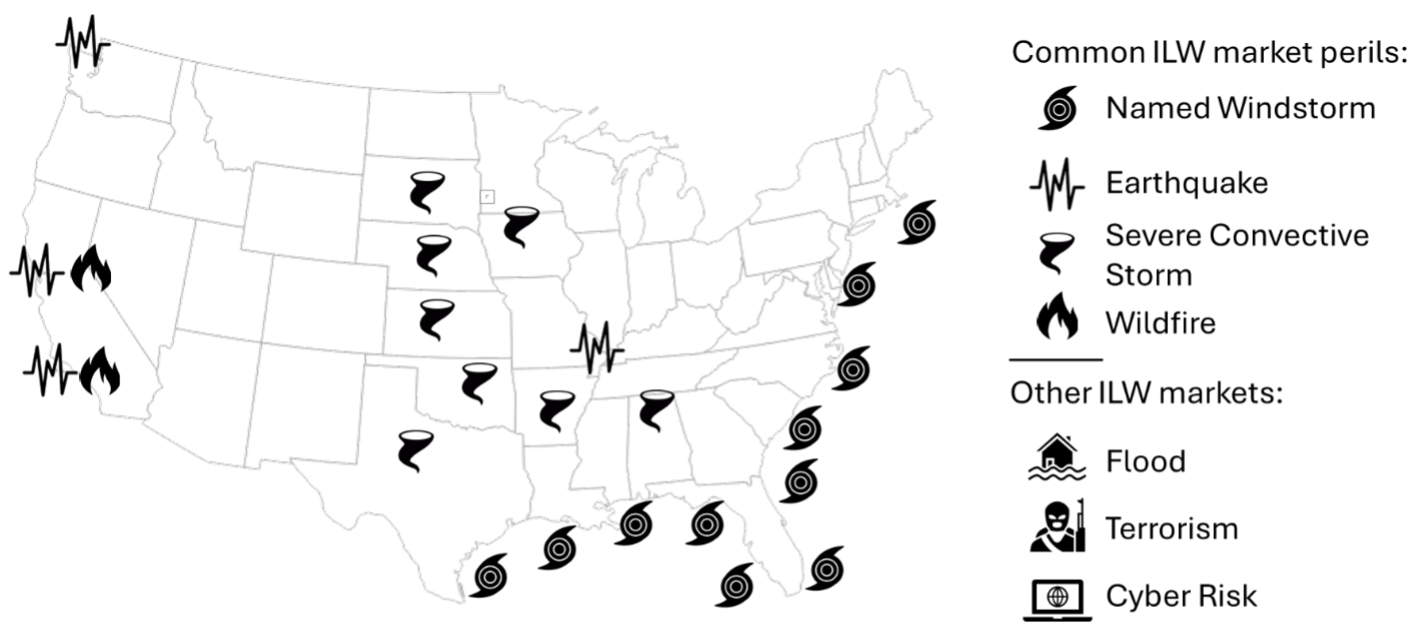
The coverage under an ILW will be defined by the perils protected by the contract, of which the major natural perils for which ILWs are bought are Windstorm and Earthquake and less commonly, Severe Convective Storm and Wildfire. The most common coverages for an ILW in the US are “Named Windstorm only” or “Named Windstorm and Earthquake”. See Figure 1 for an indicative map of US perils.
Named Windstorms are those windstorms with sustained windspeeds high enough for the storm to be issued with a name by the National Weather Service (NWS) or the National Oceanic Atmospheric Administration (NOAA).
ILW triggers
ILWs can have a variety of trigger types, which change the economics of the underlying protection. Common in the market are first loss occurrence, second loss occurrence and annual aggregate market loss triggers. An aggregate cover protects the counterparty for the sum of all loss events during the contract period – capped at the total limit. An occurrence transaction only provides coverage for individual events. Aggregate transactions often have a minimum loss threshold, called franchise deductible, that is used to filter out smaller losses. Table 1 outlines common trigger types in more detail.
| Trigger type | Description | Example |
|---|---|---|
| Occurrence | Coverage for an individual event of a defined peril and magnitude | $10bn excess (xs) $50bn – pays linearly when the total loss to the market from an event is greater than $50bn up to a total payout when the market loss is $60bn |
| Second Loss | Coverage for the second event of the defined peril and magnitude | $10bn xs $50bn – pays linearly when the total loss to the market from a second event in the same year is greater than $50bn up to a total payout when the market loss is $60bn |
| Annual Aggregate | Coverage for all events of a defined peril and magnitude in an annual period | $10bn xs $80bn in the aggregate, $5bn per occurrence franchise deductible which filters out all events below $5bn. The ILW pays linearly when the total loss to the market from all events larger than $5bn in a year is greater than $80bn up to a total payout when the market loss is $90bn |
Table 1: Common loss triggers for ILW contracts.
Role of the reporting agent
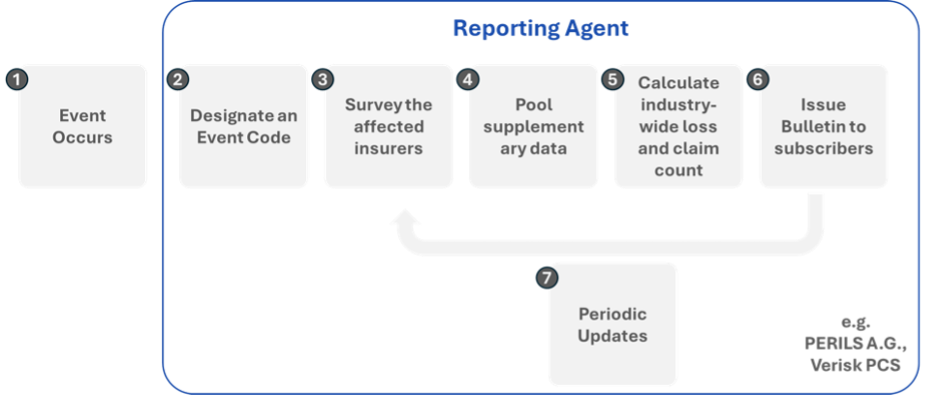
As highlighted, ILW contracts pay out in response to the entire insurance industry’s loss experience by way of a reference index. The reference index is provided and maintained by an independent third-party reporting agent with the responsibility for collating the loss experience information for the insurance industry. Figure 2 illustrates the claims estimation process. The third-party that provides this service in the USA is Verisk Property Claims Service (PCS). Details of the process undertaken can be found here.
Example US ILW structure
Table 2 outlines a classic US ILW contract. The contract has a $50m limit, which is the full amount that can be paid out to the protection buyer (e.g. insurer). The ILW covers the peril of Named Windstorm and Earthquake across the 50 states of the USA. The contract term is 12 months and stretches the whole of 2025. The underlying reinsurance contract pays zero for any loss events where the total insurance industry loss assessed by PCS is less than $60bn – the attachment – but then pays linearly from $0 at a $60bn loss event up to $50m for a $70bn ($60bn +$10bn) loss event. In exchange for assuming this risk, investors receive a premium of $11m which is expressed as Rate on Line (RoL) which is the Premium divided by the Coverage Limit so $11m/$50m = 22% ROL.
| Attribute | Details |
|---|---|
| Peril | Named Windstorm and Earthquake |
| Location | USA 50 States |
| Index and Reporting Agent | Verisk Property Claims Service (PCS) |
| Trigger | Industry Loss Occurrences reported by PCS |
| Reference Loss | USD 10 bn xs USD 60bn, Occurrence |
| Coverage Term | 12 months, starting 1 January 2025 |
| Coverage Limit | USD 50m, linear in line with reference loss |
| Premium | 22% Rate on Line (RoL) = USD 11m |
Table 2: Example ILW transaction structure.
Interested in an ILW strategy?
CatX offers direct access to the ILS market for institutional investors and provides all relevant risk models and analytics for transactions, allowing new participants to fully understand the underlying risks.
Feel free to reach out to the team to discuss all our available investment opportunities in more detail.


